
This is our
history
The United Methodist Church of Southern Africa (UMCOSA) was established on 2nd June 1978. At the inception the Church was renamed named as “The Methodist Church of Transkei”. The purpose of this name was to depict soil of origin. A swift expansion demanded a change of name, so as to accommodate the members beyond the boundaries of the home land of Transkei; hence the name United Methodist Church Of Southern Africa.
The following is a brief background so as to point out the motive behind the formation. This Church was formed up by the people who were members of Methodist Church of Southern Africa (MCSA). It was a fact that APARTHEID was a malady whose effect soiled the people’s cultures in all aspects of life. The Churches themselves could not avoid its impact. White Supremacy against Black inferiority was apparent even in Church circles. In an attempt to react against the denomination, the Black section of the Church organized themselves in a group called Black Ministers Consultation (B.C.M.) High and frequent matter in their deliberations was to get rid of the White oppression in the church which, ironically, professes to be one and undivided.
The 1977 Conference of the Methodist Church of Southern Africa was caught up in a dilemma. Some wanted to convey a long-standing practice of Conference greetings to the head of State of South Africa. They resolved to exclude the head of State in the Transkei homeland. The ministers whose homes were in Transkei felt offended. They used that opportunity to instigate a reaction by the Transkei State President who was Chief Kaizer Daliwonga Matanzima. Renounced clerics persuaded him to ban the Methodist Church of Southern Africa in Transkei.


Representations for consultations took several months (i.e. October –May). At last human nature being what it is, he reluctantly bought the idea and banned the Methodist Church of Southern Africa as an undesirable organisation in Transkei. To put in bluntly the State President of Transkei homeland was instrumentalized.
The Methodist members in Transkei used that opportunity to form a Methodist Church of Transkei. The motive being to get rid of White controlled church. Anyway the church was established, a confession of faith was coined, a Methodist discipline was adopted and the Conference became the governing authority with both legislative and executive powers. The constitution became a supreme authority. Negotiations about properties were entered into between the two churches. The Methodist Church of Southern Africa. 1979 Conference resolved that to cede her properties which were in Transkei exchange of Pensions of Ministers who opted for the new church. Seeing that the expansion of the new church was rapid, the name was changed to present one United Methodist Church of Southern Africa (U.M.C.O.S.A.) IN 1979.
After ten years, i.e. in 1988, the Military Government in Transkei under the leadership of General Bantubonke Holomisa unbanned the Methodist Church of Southern Africa, others remained an intensive rivalry about properties and memberships ensued. Big sums of money were spent in courts of law. By the GRACE of God it is now the 44th year of U.M.C.O.S.A’s existence (not without internal problems anyway), The United Methodist Church of Southern Africa has eighty one Circuits each Circuit is managed by Superintendent Minister, two Circuit Stewards, Circuit Secretary and Circuit Treasurer. All of them are elected for a period of three years by Circuit Quarterly Meeting.
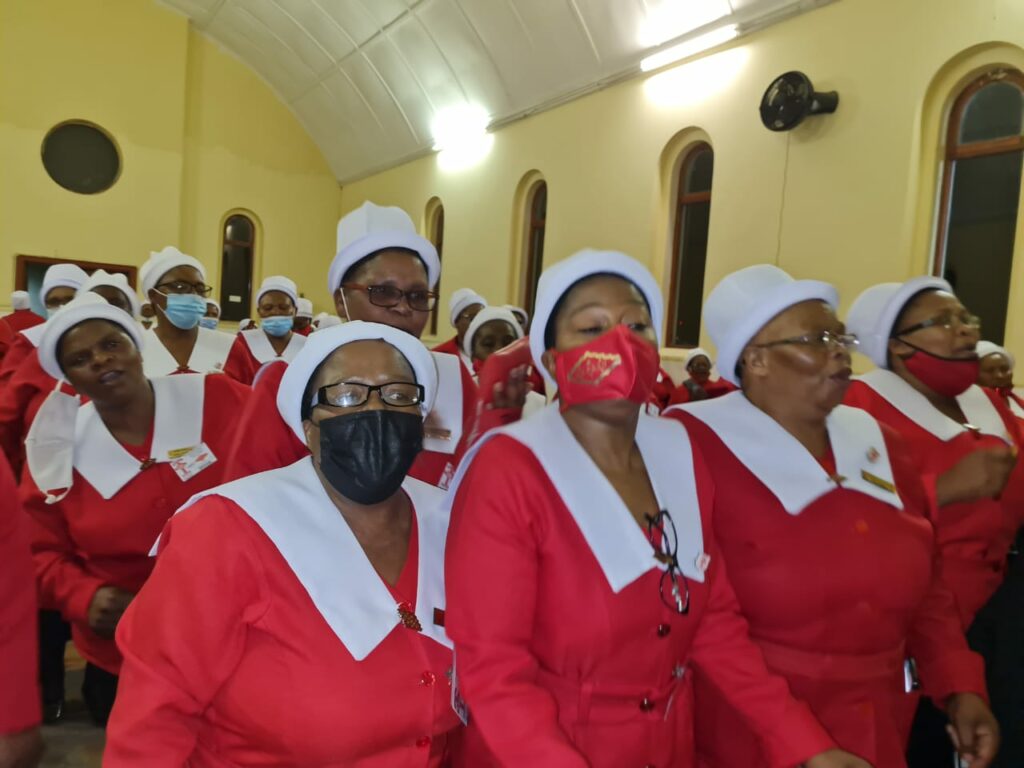

The United Methodist Church of Southern Africa had four Districts at the inception. It grew to eight Districts, which cover the ear stretching from the Limpopo River down to Cape Peninsula. Each District managed by (District Bishop,District Secretary,District Statistical Secretary, District Administrator and District Treasurer) all of them are elected for the period of three years.
The Districts are collectively called the Connexion. The Presiding Bishop, Secretary General, Church Administrator and General Treasurer together are the Executive of the Church called Hierarchy all of them are elected for the period of three years
The administrative work is partitioned into Departments and Organizations which are run by General Secretaries, General Presidents and their Committees in exception of Missionary Department and Department of Education for Ministry which are headed by Directors.